Context of Sludge Treatment
Urban wastewater treatment plant (WWTP) operators must manage large volumes of sludge generated during the treatment of wastewater. These residues, considered waste, require appropriate sludge management before being recovered or disposed of. Depending on the final destination (agricultural valorization, anaerobic digestion, incineration, or landfill), various sludge preparation and treatment technologies are used and continuously optimized to reduce energy and reagent consumption.
Why Treat and Valorize Sludge
Once extracted, sludge still contains a very high amount of water—often less than 1% dry matter. To reduce transport and treatment costs, it is essential to increase its dryness through progressive treatment steps.
Key Steps in Sludge Treatment
Sludge conditioning: Addition of reagents (flocculants, coagulants, or lime) to enhance solid-liquid separation. This conditioning improves the efficiency of subsequent stages by facilitating water management.
Thickening: The first concentration step, which transforms sludge from a liquid state to a more paste-like consistency.
Sludge dewatering: Significant reduction of water content using technologies such as screw presses, centrifuges, or filter presses.
Sludge drying: Thermal or natural drying to obtain a drier product suited for final valorization (composting, incineration, etc.).
Apromud®: an innovative complement to conventional flocculants
The Apromud® solution, developed by Aprotek, offers a different approach to sludge conditioning by adding super-absorbents polymers (SAPs) made from recycled raw materials. This non-dusty powder directly captures free water within the sludge, enabling immediate structuring of the sludge matrix.
With a very low dosage—around 1%—and effectiveness within less than 15 minutes, Apromud® greatly enhances handling safety while reducing the volumes required for transport.
Valorization: Turning Waste Into a Resource
Once properly treated, sludge can be valorized through several routes:
- Agricultural land application after stabilization, using the nutrient-rich properties of the sludge.
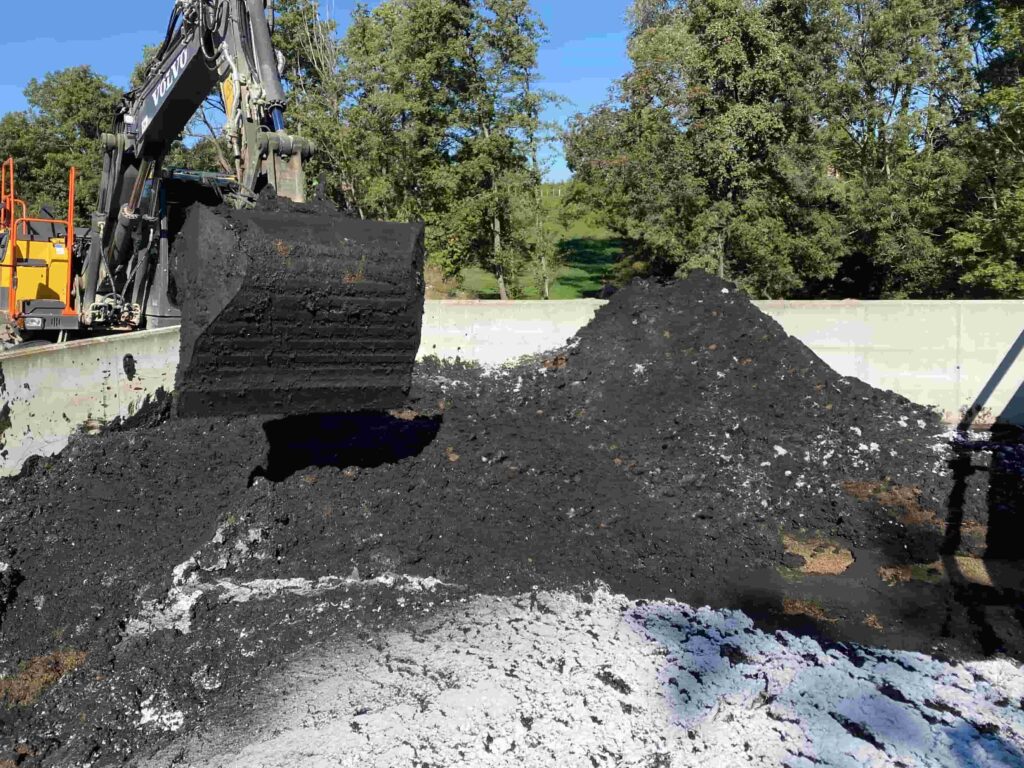
- Composting, combining sludge with other organic materials to produce high-quality soil amendments. The APROMUD® solution also contributes to valorization: protected by patent FR 3118031, it accelerates aerobic composting, improving both the stability and quality of the resulting organic amendments. This aligns with the company’s sustainable development strategy.
- Anaerobic digestion, which transforms organic matter into biogas, providing a renewable energy source.
- Drying systems and innovative solutions, such as planted drying beds or low-energy processes, producing materials adapted to specific uses.
Continuous Innovation and Optimization
Although core technologies are well established, suppliers and operators continue to innovate to improve efficiency and reduce costs. Smarter equipment now automatically adjusts polymer dosing or fine-tunes process parameters in real time to optimize sludge dewatering.
Aprotek, for its part, continues its R&D efforts to develop solutions that are increasingly efficient, economical, and environmentally friendly. As in 2025, the company will keep supporting its clients in the field, helping them streamline and optimize the overall management of their operations.